Genetic Algorithm for Minimization Problems

Published: 2025

This project focuses on implementing a genetic algorithm to solve minimization problems by evolving candidate solutions over successive generations. The system allows users to switch between functions and selection strategies to evaluate optimization performance.
This project focuses on implementing a genetic algorithm to find optimal solutions for two minimization functions. The approach allows users to dynamically switch between objective functions and selection methods in order to evaluate their effectiveness. By leveraging evolutionary computing principles, the system provides valuable insights into how genetic algorithms can be applied to complex optimization problems.
The program is designed to be highly flexible and serves as a training and experimentation tool for studying optimization behavior. Key parameters include population size, number of genes per candidate solution, mutation rate, mutation step size, number of generations, and crossover rate. Two selection strategies are implemented: tournament selection and roulette wheel selection, allowing direct comparison of their ability to converge toward optimal solutions.
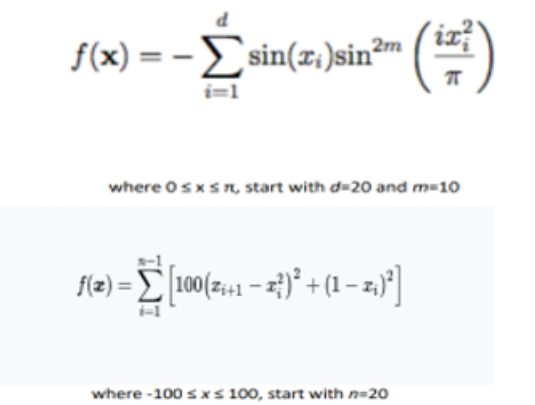
The algorithm follows a structured evolutionary workflow. An initial population of candidate solutions is generated randomly, after which selection methods are applied to choose parent individuals. Crossover operations combine genetic material from selected parents, while mutation introduces random variation to maintain genetic diversity. Each individual is evaluated using the chosen minimization function, and fitness values determine which candidates advance to subsequent generations.
Performance metrics such as best fitness value, average population fitness, and overall convergence behavior are tracked throughout execution. These results are visualized using graphs, enabling clear observation of how different parameter choices influence optimization performance over time.
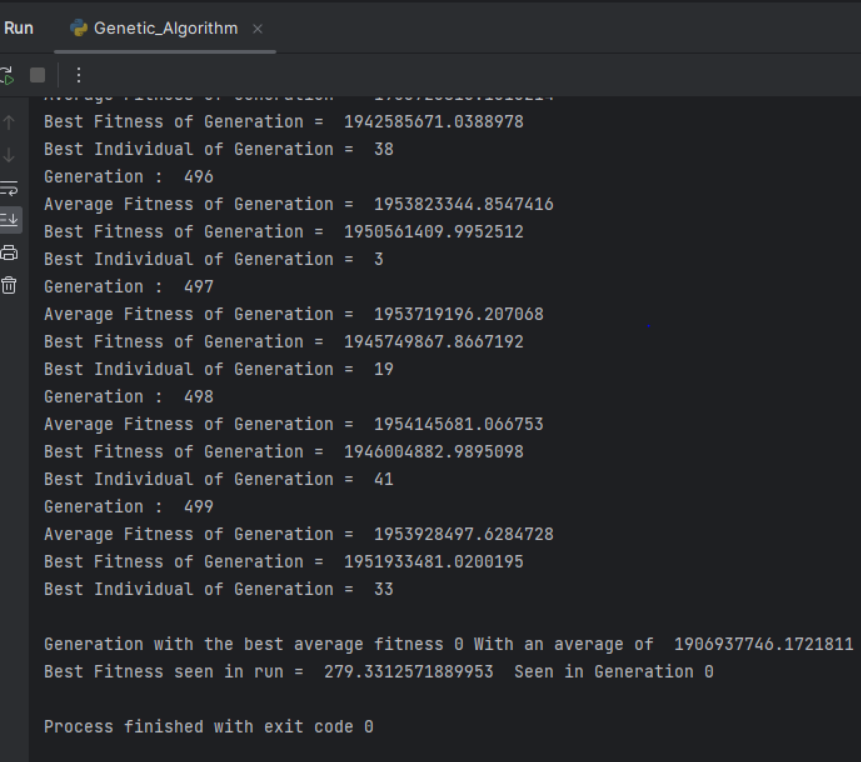
Several challenges were encountered during development, including balancing mutation rates to prevent premature convergence, tuning crossover rates to improve exploration, and maintaining sufficient population diversity. Future enhancements could include adaptive mutation strategies, hybrid optimization approaches, or extending the framework to handle more complex and higher-dimensional minimization problems.
Overall, this project demonstrates the effectiveness of genetic algorithms in solving optimization problems and provides a strong foundation for further exploration in evolutionary computing and machine learning.